
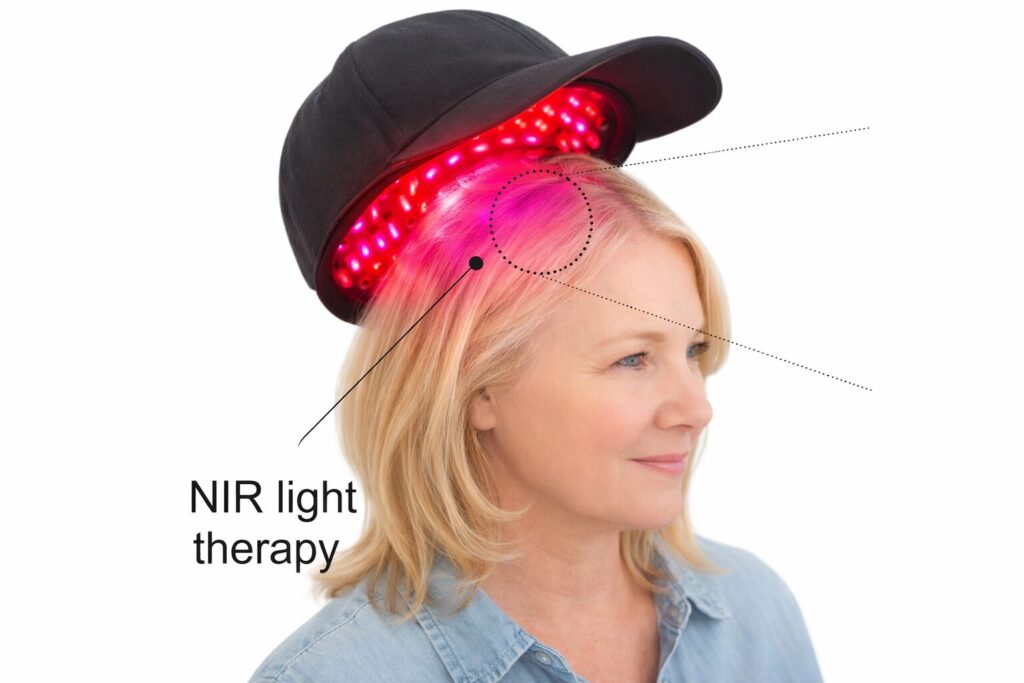
Are hair growth caps a real solution for shedding—or just an expensive gadget? Over the past few years, we’ve seen an explosion of red-light helmets, laser hair caps, and “helmet”-style devices that claim to stimulate regrowth. The appeal is obvious: at-home treatment, non-invasive, no needles, and a simple premise—apply light to the scalp to support follicle health.
But in hair health, what matters isn’t what the box promises—it’s what happens at the follicle level and what holds up over time. Here’s a complete, realistic guide from a trichology and integrated hair medicine perspective.
What is a hair growth cap, and what types exist?
When someone says “hair cap,” they may mean different formats:
- Laser hair cap (laser cap): typically combines laser diodes and/or LEDs.
- Red light helmet: rigid helmet-style device.
- Near-infrared (NIR) light helmet: similar shape, using deeper-penetrating wavelengths.
- Hair growth helmet / hair grow helmet: generic English terms for these devices.
- Phototherapy cap: a more clinical term for any wearable that emits therapeutic light.
Most of these devices use photobiomodulation, also known as low-level light therapy (LLLT) or low-level laser therapy. Differences between devices aren’t just cosmetic—they affect coverage uniformity, power output, wavelength, and dosimetry (how much energy is delivered over time).
How would a laser hair cap “work”?
The simplified theory is:
- Red or near-infrared light reaches the scalp.
- Some of that energy is absorbed by cellular components tied to energy production (mitochondria).
- This may influence processes such as:
- cellular metabolism,
- local microcirculation,
- inflammatory signaling,
- and the activity of key follicle-related cells (especially those associated with the dermal papilla).
- cellular metabolism,
In trichology, it’s often described as a “boost” to the follicular environment. It doesn’t create brand-new follicles, but it may improve performance in follicles that are still alive—especially relevant in mild to moderate androgenetic alopecia and in certain diffuse shedding patterns.
Recent scientific developments: what changed with newer technologies?
Scalp phototherapy has been around for a while, but the historical pain point was user experience:
- rigid helmets,
- discomfort,
- uneven irradiation (light “spots”),
- and difficulty covering the scalp uniformly.
In 2026, a notable technology concept was reported: a more flexible, cap-like device using “area” light emitters (rather than point sources), aiming to improve uniformity and adapt better to head contours. In lab settings, researchers described a marked reduction in cellular aging in follicle-related cells and highlighted near-infrared wavelengths around 730–740 nm as potentially relevant for dermal papilla activation.
Clinical translation: this does not mean “it cures hair loss,” but it does show where research is heading—more wearable devices, better light distribution, and more precise parameters (not all light is equivalent).
What types of hair loss might benefit from a hair cap?
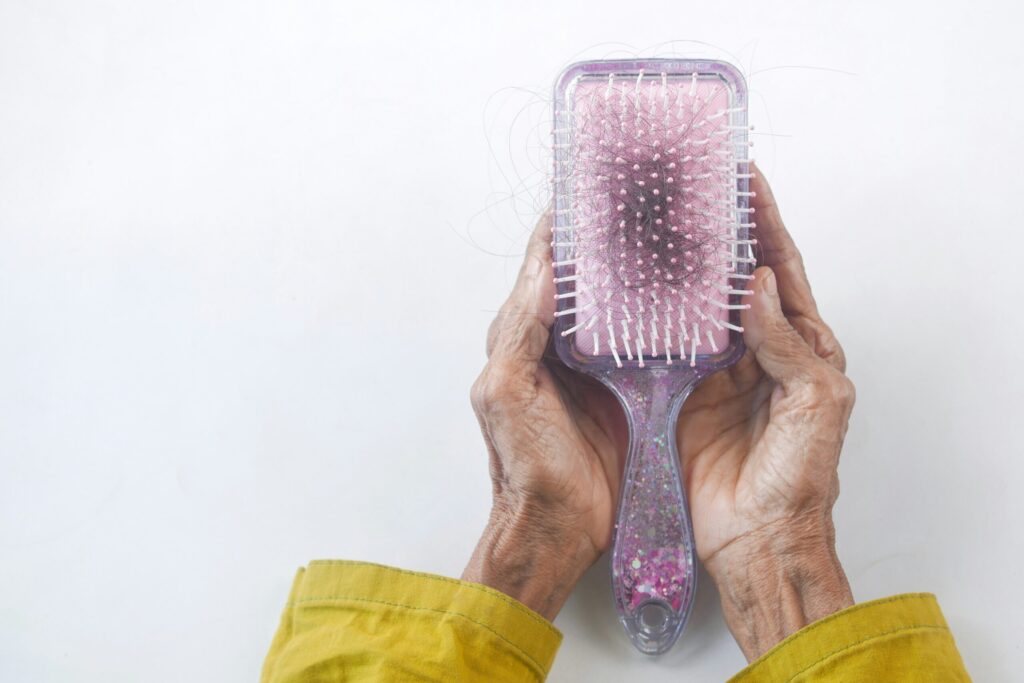
This is where many people go wrong: a hair growth cap is not “for everything.”
Scenarios where it may help (as a supplement)
- Mild to moderate androgenetic alopecia (pattern hair loss): miniaturized but living follicles.
- Diffuse female pattern thinning: when there is thinning and density loss with recoverable follicles.
- Diffuse shedding during recovery phases (e.g., post-stress), as long as there isn’t an ongoing uncorrected trigger.
Scenarios where it often disappoints if used alone
- Advanced hair loss (areas already depleted of follicles).
- Scarring alopecias or active inflammatory scalp disorders (require medical management).
- Nutritional-deficiency-related shedding not corrected (iron, protein, etc.): light can’t replace causal treatment.
- Unrealistic expectations (returning to teenage density using only a cap).
Key integrated-hair-medicine point: if the underlying cause isn’t treated, the cap may contribute little or nothing.
Real benefits of hair growth caps (when properly indicated)
- Non-invasive: no needles and no surgery.
- At-home use: can improve adherence for consistent users.
- Generally well tolerated for most people when used as directed.
- Useful add-on: can complement medical or regenerative treatments depending on diagnosis.
Strategically, if a patient already has a baseline plan (medical/topical and/or procedures), phototherapy can act as a supportive “co-factor” that helps push results and support the follicular environment.
Limitations and the fine print most people don’t hear
1) Not magic: it takes time and consistency
Hair cycles are long. Using a cap for two weeks and stopping doesn’t allow meaningful evaluation. A realistic minimum is several months of consistent use.
2) Results are variable
Not all alopecias respond the same, and not all scalps are alike. Baseline density, degree of miniaturization, inflammation, and genetics matter a lot.
3) Devices vary widely
Two “laser caps” can be completely different in output, distribution, wavelength, build quality, and diode lifespan. That’s why some devices help more and others end up being expensive placebo.
4) False sense of security
The biggest risk is delaying proper treatment. If someone has progressive hair loss and relies only on a cap, they may lose valuable early-treatment time.
How to choose a hair cap (without buying hype)
If you’re considering a hair growth cap or red-light helmet, use this checklist:
1) Safety and certifications
Ideally, the device should have recognized regulatory clearance or certification. Testimonials alone are not enough.
2) Clear, specified wavelength
Reputable devices state their wavelength range (red, near-infrared). If it’s not specified, that’s a red flag.
3) Uniform coverage
Uniform irradiation matters. A device with too few light points may leave untreated areas.
4) Usability (adherence)
If it’s uncomfortable, heavy, or overheats, you won’t stick with it. Without consistency, there’s no real evaluation.
5) Warranty and support
These are electronic devices and can fail. A brand without support can leave you stuck mid-protocol.
Safe-use guidelines (what’s worth doing)
- Follow the manufacturer’s protocol (session duration and frequency).
- Avoid “double dosing” out of anxiety—more is not always better.
- Don’t use on active scalp lesions without medical guidance (e.g., infections, severe dermatitis).
- If irritation, increased itching, or worse scaling appears: pause and consult.
Most importantly: don’t use a cap as your only treatment if you have diagnosed hair loss that requires medical management.
Should you combine a hair cap with minoxidil or finasteride?
In many real-world hair plans, phototherapy is used as a supplement. The exact combination depends on:
- diagnosis (androgenetic vs telogen effluvium vs others),
- sex, age, and medical history,
- medication tolerance,
- goals (reduce shedding, thicken hair, maintain results, prepare for or support post-transplant care).
In simple terms: the cap can be a “plus,” but it rarely replaces a baseline plan in androgenetic alopecia.
FAQs
Generally, no. It may support living follicles. If an area has been fully bald for years, a different approach is usually needed.
It depends on the device and its protocol. What matters is a stable, measurable, safe schedule.
If it works, changes tend to be gradual. Many people notice reduced shedding first, then improvements in texture/shaft thickness. A realistic evaluation window is months—not weeks.
Is a laser hair cap worth it?
Hair growth caps aren’t a scam by definition—photobiomodulation is a real, evolving field. The mistake is buying a cap as a universal solution, without diagnosis or strategy.
It may be worth it if you:
- have a compatible diagnosis (e.g., mild/moderate pattern hair loss),
- want a non-invasive add-on,
- can commit to consistent use and follow-up.
It’s probably not worth it if you:
- expect quick results,
- have advanced hair loss,
- or are replacing medical treatment you actually need.
Before investing in a hair growth cap, the most efficient step is a trichology evaluation to define the type of shedding, follicle status, and an integrated plan. Only then does it make sense to decide whether a laser cap will truly add value in your case.